
Interview by Nelson (Mr Luxury)
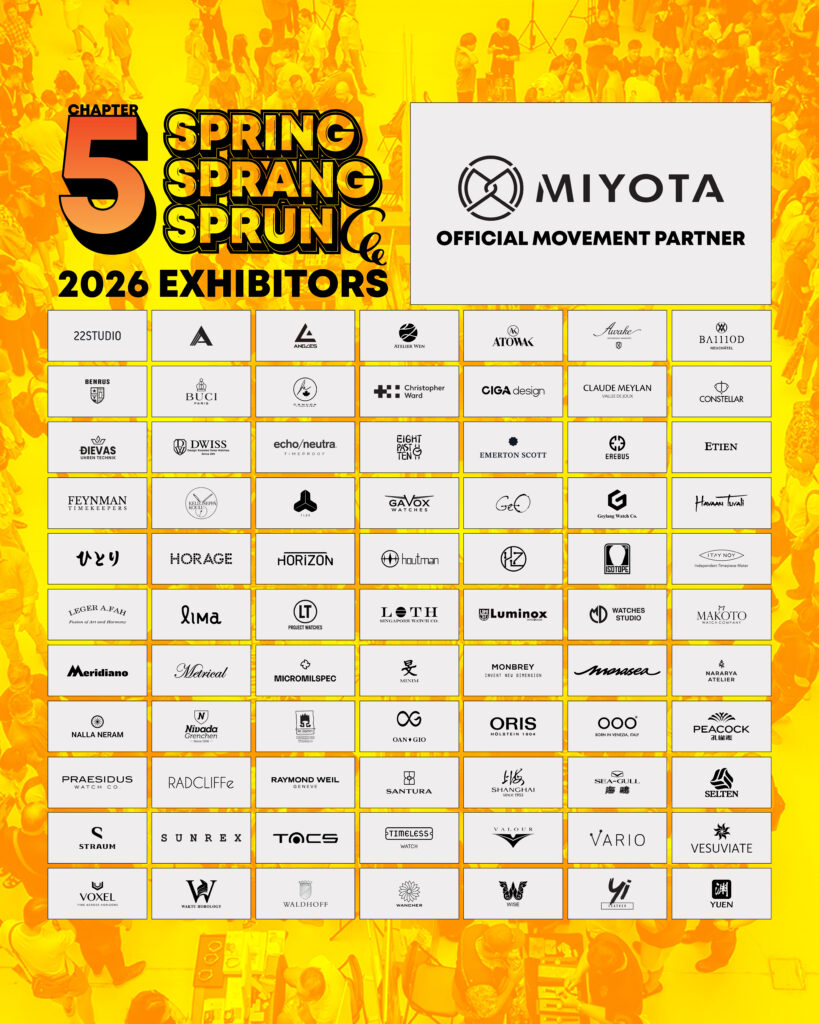
Five years ago, Sugi, YK & Wanyu decided Singapore’s independent watch scene needed a room of its own. Spring Sprang Sprung — SPRG to regulars — has since grown from 22 brands to 78, moved venues three times, and started drawing collectors, watch groups and media from across the region. The whole operation is still run by three people: Sugi, YK and Wanyu. Ahead of this year’s edition, we sat down with Sugi, YK and Wanyu to talk about the name, the growing pains, who gets a table, and what’s new on the floor.
Q1: How the idea came about
SUGI: I think it’s a natural extension of what we’ve been trying to do: promote non-mainstream brands and independent labels. The next stage is a bigger platform where all the brand owners are present, meeting potential customers and the public and telling their stories in person. I’d personally wanted to do that for a long time. It’s a natural extension of what we’ve been doing for the past 21 years.
YK: For me it was natural because I’m a microbrand owner too. Building the community in Singapore benefits us and every microbrand here. That’s where the initiative came from. The aim is to build the community. We could see a lot of brands starting up in Singapore, each doing their own thing, with no platform to bring everyone together. Singapore isn’t big, so it makes sense to do things together. That makes a stronger community than every brand doing it alone.
Q2: The story behind the name
SUGI: I started with the word “spring”. Most people think of the season. Watch lovers think of the balance spring, the mainspring, all the springs inside the mechanics. That was my first thought. But “spring” alone wasn’t fun enough, so we continued with the past and perfect tenses. It means something for microbrand owners too. You have the idea, you spring the idea around, you execute it, and then it’s sprung, it’s done. It’s the natural progression from having an idea, sharing it, executing it and eventually having your own brand, and maybe growing it to a bigger scale.
Q3: From 22 brands to 78 — what was lost?
YK: Nothing, except time. It takes much more effort to manage in the same timeframe. In one year, contacting 22 brands is very different from liaising with 78, so we sacrifice a lot of our own time. To be honest, the whole company is just the three of us: me, Sugi and Wanyu. The challenge is always how to manage as we grow, because there are more questions, more enquiries—
SUGI: —and expectations. From the exhibitors’ point of view, they may not realise it until the day itself. If there are more brands but visitor numbers don’t increase, each visitor spends less time with each brand. We haven’t reached this level before, so there’s a risk. We’re hoping two days is the ideal for 3,000 to 4,000 visitors. Beyond that, we either add days or cap it at 70-something brands. So we’re taking a bit of a risk this year.
Q4: Who gets a table, and who was hardest to turn down
SUGI: We’ve grown organically, but returning brands get priority. They became exhibitors in the first place because we curated them, since space is limited. Brands that have come back for the past three years get priority. As slots grow, we have to be more selective. First, a brand has to fit the microbrand criteria. This time we’re also creating a separate space on the second floor for Swiss-made, more luxury but still independent brands. We call it Chronoscape. It could grow into its own fair, either alongside SPRG or separately. To us, microbrands and independents have a lot in common. They’re not governed by big corporations. Collectors may see a difference, but for us it’s still one or two people creating the entire brand. That’s why we mix the two.
YK: Saying no is unavoidable, because we have to select. We look for brands that are interesting, things we’ve never seen before, brands that are really creative. This year we have a cement watch from Taiwan by 22 Studio. We’d never seen anyone use cement on a watch. That’s what we look forward to and what we think visitors will find interesting, rather than another brand that looks like a Submariner.
WANYU: They’ve been around a long time, with a brutalist series inspired by 21_21 Design Sight in Roppongi, and now they have different colours. Even after five years, there are still a lot of brands we don’t know.
Q5: A Singapore fair, or a regional one?
SUGI: Very regional, if you ask me. We started in Singapore, and we still hope more Singaporeans get into the hobby and join the community. But as the fair gets bigger, more people from neighbouring countries want to attend, and not just visitors but media too. It has grown into a regional fair.
YK: Last year we had watch groups from Thailand who came together, and watch groups and influencers from Hong Kong. We hope more groups from different countries come as we grow.
Q6: SPRG, IAMWATCH and Golden Hour in the same week
SPRG: Not this year. We did coordinate two years ago with IAMWATCH. This year, for some strange reason, they just happen at the same time. That’s a good thing.
Q7: Which booth will empty the most wallets?
SUGI: I didn’t have time to buy watches. I was too busy going around.
WANYU: Historically, since Oan Gio joined us they’ve done very well, not just at the fair but after it too. Lima as well.
YK: I think they’ll keep emptying the most wallets. Wise is coming back and will draw eyeballs, but they mostly take orders online. It’s hard to say, because price ranges differ. Last year Lima and Havaan Tuvali did very well and cleared their tables on the first day. With so many new brands, a new design may also catch visitors’ eyes.
Q8: What’s new this year
SPRG: A digital art class for watch art. It’s a first for us: you register for the workshop, and the artist gives a two-hour crash course in digital art. It’s $30. He’ll also be exhibiting his work, so you can buy a piece or commission one. Then there’s Chronoscape. It’s not entirely new, because we’ve done similar things over the years, but this time we decided to give it a name. And merchandise: a new set of T-shirts. The front stays the same, and the back comes in three designs, in white, black and pink. You can buy them at the fair or order online. In previous years the shirts were only for staff and special friends, but we got a lot of requests.
There’s one workshop per day, with limited places. Saturday is the watchmaking workshop by Alvin’s team, and Sunday is digital art.
Q9: Giving every exhibitor a fair chance
YK: This year is interesting because we’re doing what I call the IKEA style. In IKEA you can only go one direction, so you pass through every section. We’re doing the same: one direction, through every booth. As organisers, we do our best to make sure everyone passes every booth. Whether people stop at yours is up to the brand owner. We always encourage brand owners to engage people. We can’t force visitors to your booth. You have to take the initiative and start the conversation.
Q10: SPRG in five years
SUGI: In terms of awareness, it’s no longer local, it’s regional, and now beyond. Someone in Dubai just texted me that he’ll be in Singapore for IAMWATCH and will visit our fair too. Dubai, Australia. What I’d never want to change is the casual approach. We don’t want it too formal. We’ll keep focusing on independent microbrands, but it won’t be 100% microbrands. We won’t say no to bigger independent brands, which is what we’re doing with Chronoscape.
Quick-fire
What’s on your wrist right now?
YK: Orient Star.
SUGI: A Shanghai watch, 上海表. We’re seeing more and more participation from China. They’re eager to be part of it, and there’s a big Chinese contingent this year: Ciga Design, Shanghai, Peacock, Atowak, Angles. A Hong Kong group that organises a watch week also proposed bringing their whole group of exhibitors, but they only raised it in September, which was too late.
The best booth you’ve ever seen at SPRG?
SPRG: Booths are fairly standard because we want consistency, but we don’t restrict what brands put on their tables. Last year it was Tristan (LOTH). He brought a TV and did live finishing on it, which we’d never seen before. Also look out for No Identity, a Hong Kong brand. Their booth last year was very nicely done and interactive, and this year they want a mahjong theme.
One brand you’d love to see exhibit next year?
YK: I just spoke to Jonathan from Brew Watches in New York. He’s keen to join if his schedule allows, and I hope he can.
The best thing a visitor ever said to you at the fair?
SPRG: “Sugi, my pocket is empty now.” (laughs)
YK: For me, what brand owners say means more, especially new brands who thank us for creating the event. We understand the challenge of a new brand: low budgets and no platform to showcase their product. SPRG is the perfect place, especially when they’re launching their first watch. As a brand owner I feel that deeply. When I started my brand years ago, there was nothing like this. There was no way to reach 4,000 people at one event. At most we’d get 80 or 100 people. So it feels good knowing brand owners appreciate the platform we’ve created and that we keep it affordable enough for them to join.