
Reading Time: 5 mins.
The movement is the only thing to see.
On convicon, independence, and the philosophy of making. Few watchmakers alive today have reshaped the industry’s idea of what a
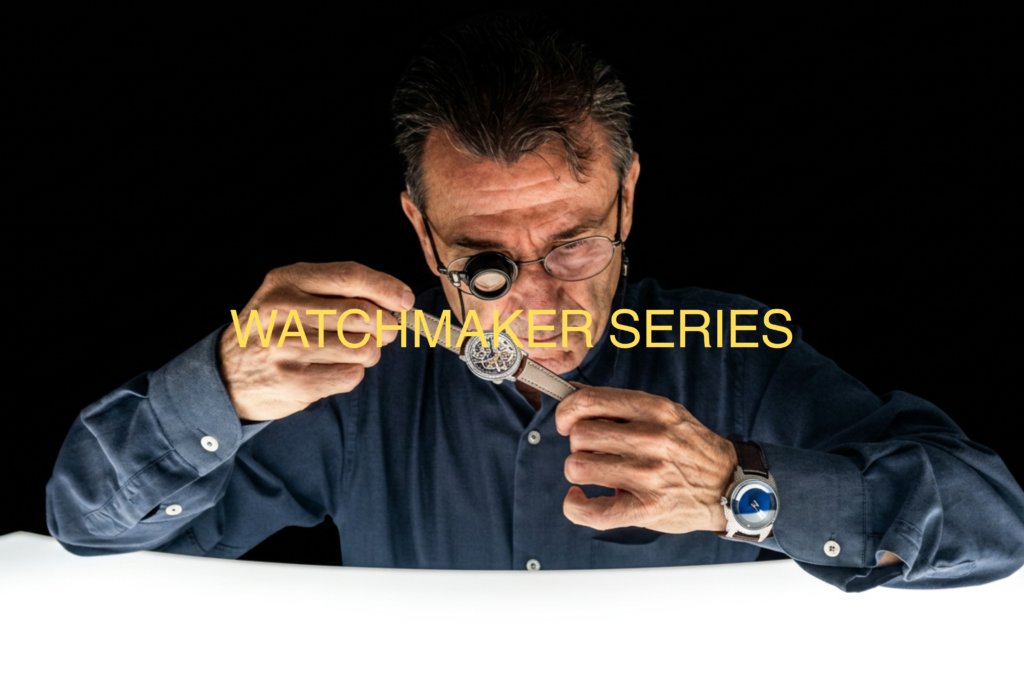
watch can be. Vincent Calabrese — self-taught, Italian-born, Geneva-based — invented the linear Golden Bridge movement in 1977 as a direct rebuke to the noon that a movement was mere machinery to be hidden. Co-founder of the AHCI alongside Svend Andersen and recipient of the GPHG Special Jury Prize in 2023, he remains one of the most consequenal independent voices in
horology.
Here, he speaks on the state of the craft, the tension between technology and tradion, and why the future of watchmaking is a philosophical queson as much as a technical one.
The Golden Bridge was born from a refusal — a refusal to accept that the movement should be invisible. Fifty years later, does that original anger sll drive you, or has it become something else? The Golden Bridge was not born out of a rejecon, but out of a compelling desire to put an end to the age-old conventions of classical watchmaking. Fi!y years on, that desire has been partly fulfilled. Partly, because, on the one hand, this alternave form of watchmaking that I so ardently longed for is now a reality, and, on the other hand, there are sll many other watchmaking revoluons yet to be achieved.
One might say that a smartwatch is a wrist accessory that is seen and shown off, but whose heart does not beat. The mechanical watch possesses a beauty of a completely different kind, far more poec, and one can hear its heart beang amidst the mysteries of its internal mechanism. That alone is enough for the ‘mechanical’ to hold its own against the ‘smart’.
The AHCI has brought many highly talented watchmakers out of obscurity and, above all, provided the opportunity to revoluonise watchmaking in many areas. It has reawakened enthusiasts of mechanical watchmaking. This is where Les Indépendants hold the upper hand over the major brands. The flip side of the coin is that many of them have succumbed to markeng and allowed themselves to be swept up in the excesses of commercialisation, at the risk of killing their creativity.
Evolution has never destroyed tradition if, as in watchmaking, it respects basic principles such as precision. The balance spring is a component of the mechanism that is not perfect. It was a good invention at the end of the 17th century (thanks to Chrisaan Huygens) for portable masterpieces, but in the 21st century we can expect be7er. As proof of this, many watchmakers have tried to eliminate the hairspring’s flaws by inventing ultra-complicated mechanical systems… which have only served to exacerbate its shortcomings.
No matter how skilled a cra!sman may be, the work of his hands will always be less perfect than a component made by industrial machinery. It is the method of manufacture that makes the difference. On the other hand, it is a pleasure to recognise a craftman ‘signature’ in the finish of his work or the distinctive nature of its construction. This is what gives the object its full value and, once again, its beauty.
Alas, speculaon and the pursuit of profit are fundamental human vices! That will always be the case. A brand’s reputation misleads the general public and also misleads collectors – at least those who pay no attention to the watchmaking quality of the masterpiece.
I can only welcome the emergence of a new generaon of independent watchmakers in Asia and elsewhere around the world. Watchmaking is not the exclusive preserve of the Western world.
What do you prefer? A watch handcrafted by a watchmaker, or one made by a soulless corporation? See also my answer to question no. 2
If you do your research properly, you will find that I have done a great deal of work for the ‘major watchmakers’, but have always insisted that my name be credited (e.g. the Golden Bridge). That said, it is clear that by maintaining my independence, I have been able to express myself freely, though this was o!en a challenge.
A watchmaker who keeps commercial consideraons at arm’s length will be free to express his art, even if constrained by trends in the watch market. He will need to draw on the experse of discerning collectors, without becoming a slave to them.
Interview By: Mr Luxury. Largely in Vincent’s own words. Morges – Switzerland, 17th June 2026
This site uses cookies to offer you a
better browsing experience.