
Reading Time: 10 mins.
Before Switzerland claimed dominance over the watch industry, before Geneva established its conventions and the Vallée de Joux its mythology, the craft of precision timekeeping was, in significant measure, a French affair. Paris was its centre of gravity.
Abraham-Louis Breguet — the watchmaker’s watchmaker, the man whose name adorns a spring, a hand style, and a guild of imitators — worked at Quai de l’Horloge on the Île de la Cité. Pierre Le Roy defined the lever escapement. Jean-Antoine Lépine reconfigured the plate architecture of the pocket watch in ways that still echo in movements assembled today. Ferdinand Berthoud held the title of Horloger de la Marine Royale and spent a career improving marine chronometry that navigators staked their lives on. These were not men working in a tradition. They were creating one.
What followed the Revolution and the Napoleonic age was, inevitably, dispersion. Trade routes shifted. Industrial capacity concentrated across the border. The Jura became the spine of the world’s watch industry, and Paris — still a centre of taste, still home to the ateliers that adorned cases in enamel and guilloché — gradually ceded mechanical authority to Switzerland. For more than a century, French watchmaking existed in that specific tension: proximity to the world’s greatest horological culture, but without the infrastructure to rival it.
And yet France kept making watches that mattered. Not many. Not always. But enough to remind the industry where the wristwatch came from.
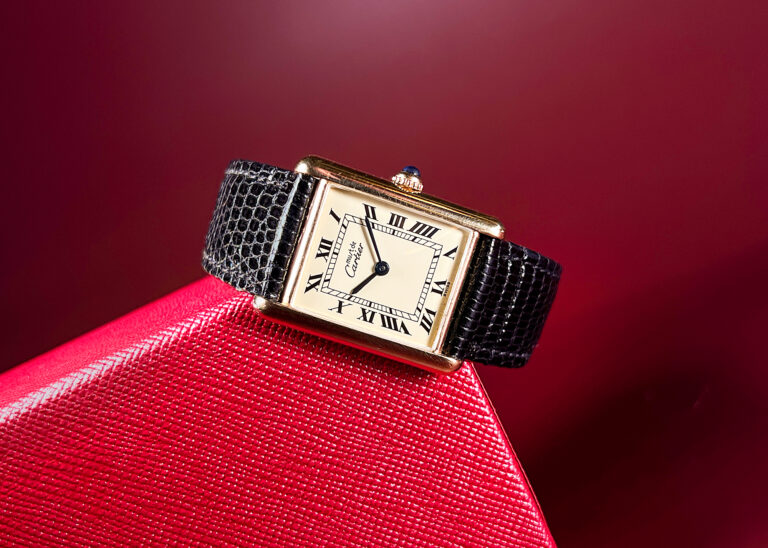
Louis-François Cartier founded his maison in a Parisian workshop in 1847, at the age of twenty-eight, as an apprentice to master watchmaker Adolphe Piccard. Britain’s King Edward VII would later call him “the jeweller of kings and the king of jewellers.” But it was his grandson, Louis Cartier, who made the contribution to horology that no other French name can claim.
In 1904, the Brazilian aviator Alberto Santos-Dumont — a fixture of Parisian high society, a pioneer of flight, and a close friend of Louis Cartier — expressed a practical frustration. He could not read a pocket watch while keeping his hands on the controls of his aircraft. Cartier’s response was a square-cased wristwatch, developed with movement maker Edmond Jaeger, with a pronounced bezel, visible screws, and a leather strap. It was called the Santos. It was, by the consensus of horological history, the first purpose-built men’s wristwatch. Santos-Dumont wore it on November 12, 1906, when he became the first person filmed in powered flight. He had the watch before the world had commercial aviation.
The Santos entered public production in 1911. From that moment, the wristwatch stopped being a women’s accessory or a military curiosity and became a language — legible to anyone who wore one. No Swiss brand can make that claim. No other French brand can either. Cartier did it first, in Paris, because two men who moved in the same circles found a shared problem worth solving.
Thirteen years later, Louis Cartier designed the Tank. The rectangular case, with its parallel side bars mimicking the tracks of a Renault FT-17, was an exercise in architectural reduction at a moment when Art Deco was reorganising European taste around geometry and restraint. The Tank’s first prototype was gifted to American General John Pershing in 1918. By the time it went into production in 1919, it had already been worn as a statement. Jacqueline Kennedy Onassis wore one. Andy Warhol wore one — and admitted openly that he did not wear it to tell the time. The Tank is what happens when a Parisian jeweller decides that the watch case is an architectural object, not merely a container for a movement.
What Cartier established across those two decades — the Santos in 1904, the Tank in 1917, and the Tonneau and Crash and mystery clocks that followed — was a distinctly French proposition: that a watch is primarily a designed object, that its form can precede its function, and that the relationship between watchmaker and client can be as personal as any friendship. These are not Swiss ideas. They are Parisian ones.
Cartier today sits within the Richemont group — a maison at institutional scale, with in-house manufacture calibres, an AHCI-adjacent design language, and a client list that spans a century of cultural power. It is not independent watchmaking in the sense that Baltic or SpaceOne is independent. But it is French watchmaking in its most consequential form, and no history of Paris and the wristwatch is honest without it. The Santos made the wristwatch real. The Tank made it art. Everything that followed — including the ateliers of Auffret and the workshops of the new French independents — works within the space those two objects opened.
The Lycée Edgar Faure in Morteau sits minutes from Switzerland. The Jura Mountains frame it. Students who train there are as likely to commute into Swiss workshops as they are to stay in France — the border is a technicality; the trade is shared. It is here that Théo Auffret received his formation, studying under Jean-Baptiste Viot and later apprenticing at Luca Soprana’s Ateliers 7h38. Auffret emerged from that lineage a movement constructor in the classical sense: someone who does not simply assemble but originates. In 2018, he won the Young Talent Competition co-organised by the Fondation de la Haute Horlogerie and F.P. Journe — an endorsement that carries genuine weight in a field where Journe’s approval is not given lightly.
His Tourbillon à Paris, produced under his own name, drew deliberate lines back to Breguet and Berthoud. The complications were classical; the finishing was Parisian. The price — north of €100,000 — placed it firmly within the realm of serious independent horology. This was not a microbrand exercise. It was a statement of intent: that France still had something to say about the inside of a watch.
While Auffret was building tourbillons at his atelier, a different kind of French watch brand was taking shape. Baltic, founded by Étienne Malec in 2016 and shaped creatively by Jas Rewkiewicz, launched on Kickstarter with a straightforward thesis: produce honest, well-proportioned watches with genuine vintage references, assembled in France, at prices that did not require a boardroom conversation. The Baltic Aquascaphe. The Tricompax chronograph. The MR micro-rotor dress watch. Each one legible, each one quietly correct.
Baltic grew from microbrand into something harder to categorise. It was not trying to be Swiss. It was not performing luxury. It occupied a space that the broader independent watch market was beginning to validate — the idea that considered design and honest construction, delivered at accessible price points, constituted a coherent position rather than a compromise.
By 2021, Baltic had moved into new headquarters in Paris. To mark the occasion, they opened their doors to the French watchmaking community — the ateliers, the independents, the craftsmen working quietly in a city better known for fashion than for calibres. It was an evening of shared profession and, as it turned out, something more consequential.
At that gathering, Théo Auffret met Guillaume Laidet for the first time. Laidet is a different kind of figure in this world — an entrepreneur by orientation, responsible for the revival of Nivada Grenchen, Excelsior Park, and Vulcain, brands that required the particular combination of historical patience and commercial instinct he appears to possess in equal measure. The conversation that began that evening in Baltic’s Paris office would eventually become SpaceOne.
SpaceOne launched in 2023. The aesthetic was a deliberate inversion of everything Auffret’s eponymous work represented. Where the Tourbillon à Paris looked backwards — to guilloché, to hand-engraving, to the vocabulary of 18th-century French haute horlogerie — SpaceOne looked outward. Futuristic typography. Cockpit-style sapphire displays. A visual language that referenced aerospace before it referenced Breguet. The jumping-hour module at the centre of SpaceOne’s first release was, nonetheless, a product of Auffret’s workshop: nine components, Swiss-manufactured, assembled in France. The outer form was radical. The inner discipline was classical.
SpaceOne sold around 600 units of its first jumping-hour piece. It was, in Laidet’s words, a brand that within a year had grown larger than Auffret’s own workshop. The approach — high-complication thinking at accessible prices, French creativity over Swiss convention — was finding its audience.
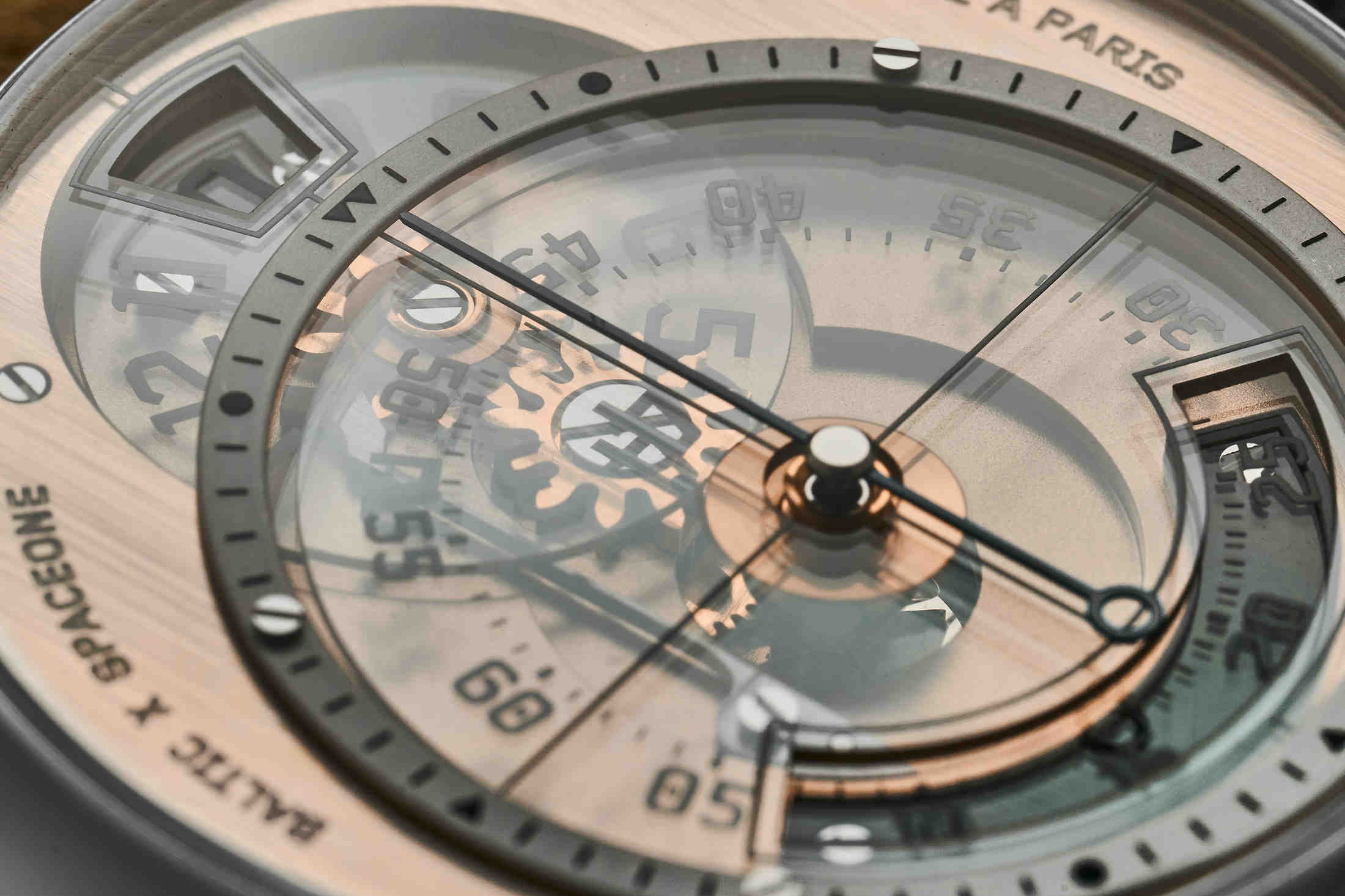
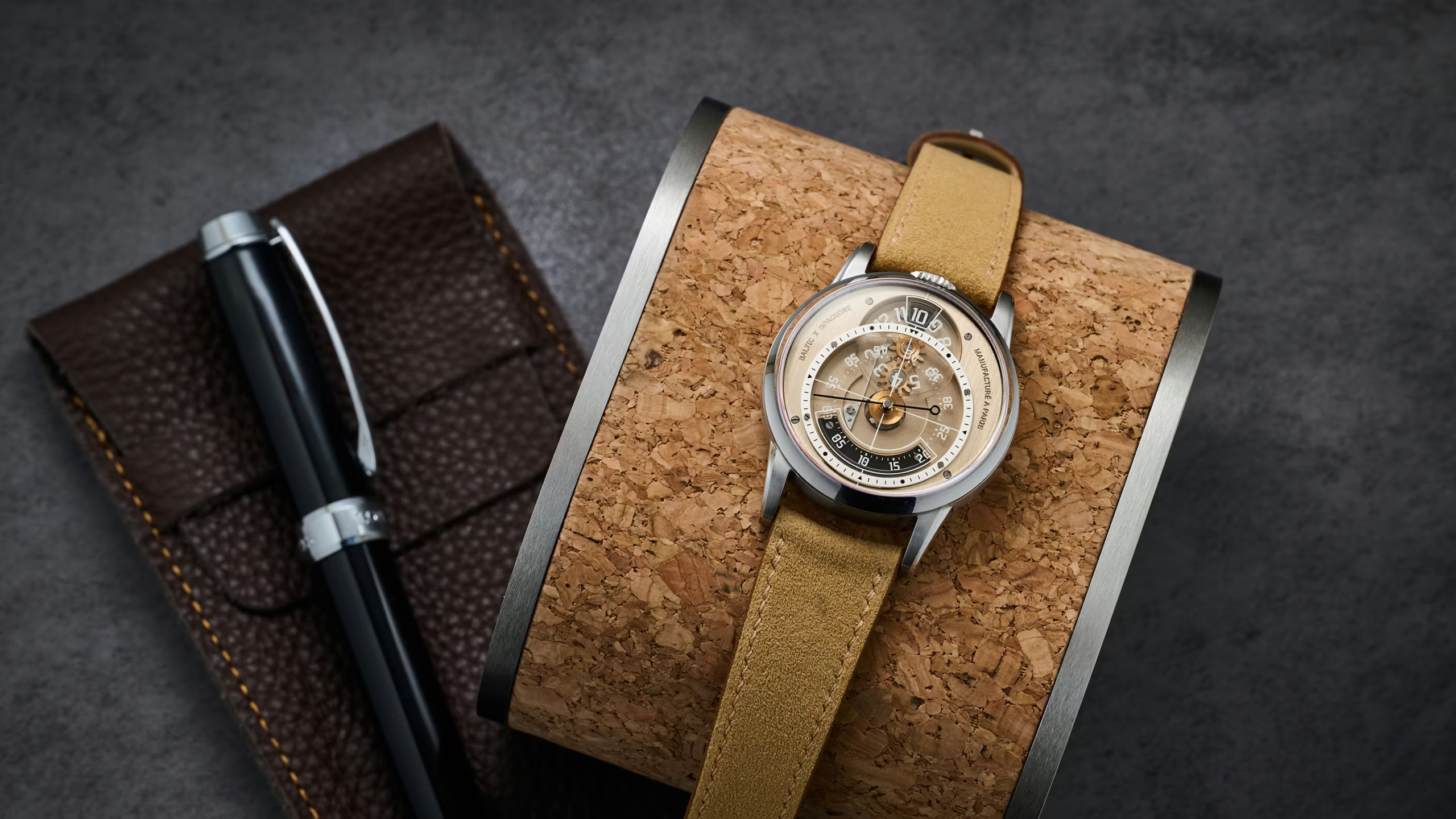
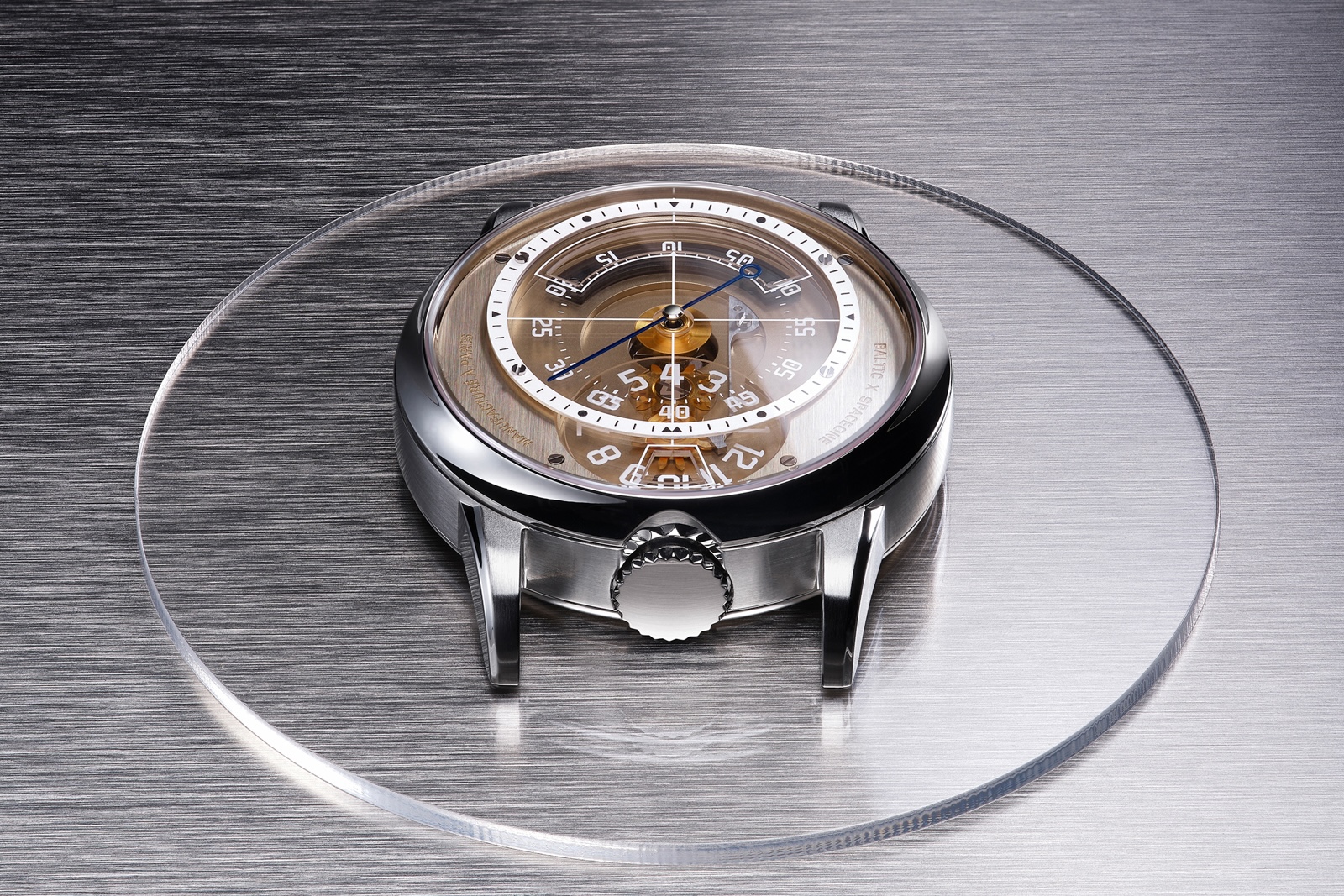
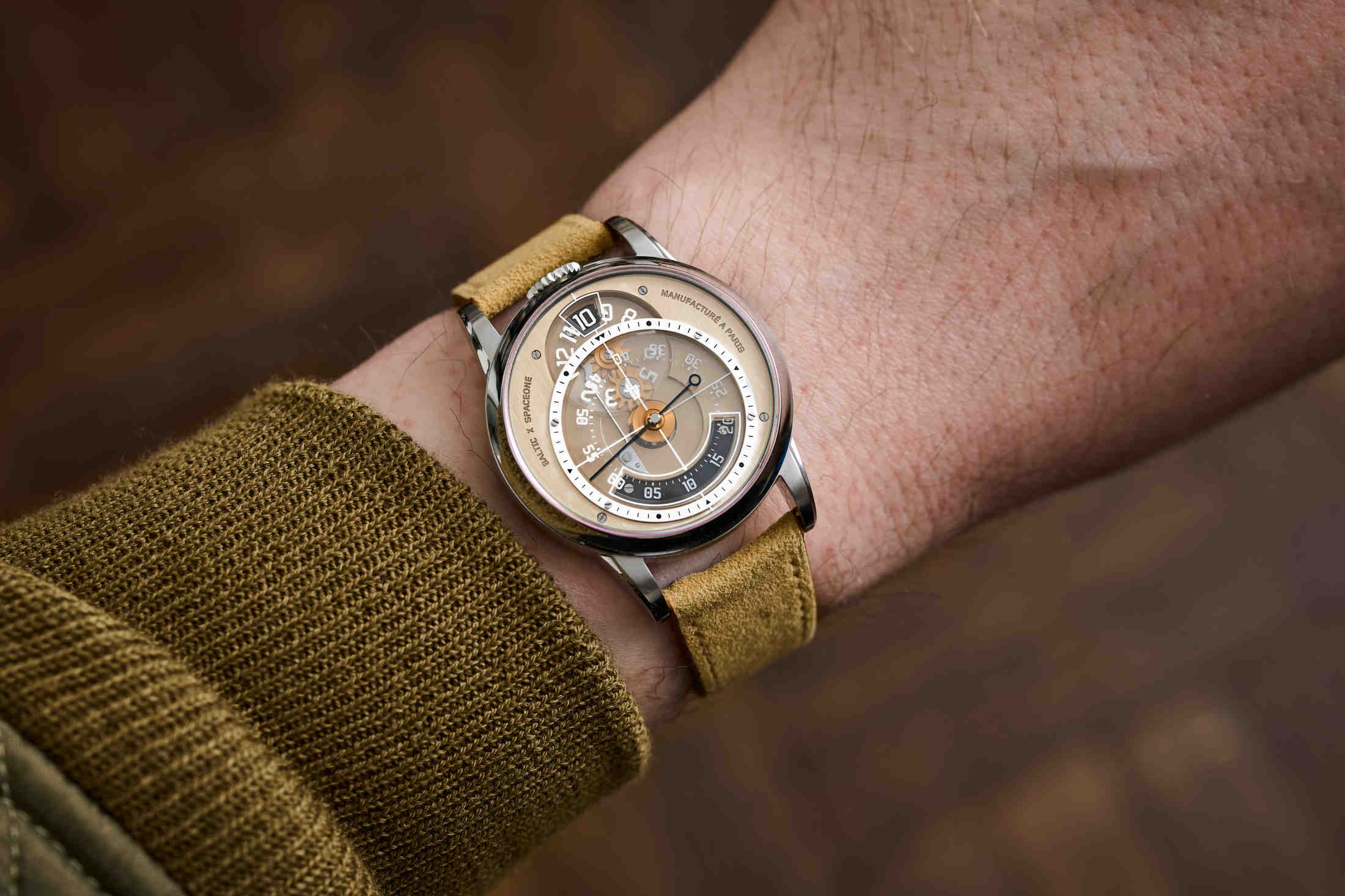
There is, on paper, no obvious reason for Baltic and SpaceOne to collaborate. The brands share a city and, as it turns out, a founding moment — but their respective aesthetics are at genuine odds. Baltic’s references are mid-century European. SpaceOne’s are science fiction. To combine them risks producing something incoherent: a watch that reads neither as vintage nor as future, that satisfies neither constituency.
The Baltic × SpaceOne Seconde Majeure does not fall into that trap. It succeeds because it is not a compromise. It is the product of a friendship that predates both brands’ current forms — a creative trust built over four years before a single component was drawn.
The case, designed from scratch for this project, is 38.5mm in 904L stainless steel. At 12.3mm thick, it sits within the proportional language of the current independent watch moment — neither a dress watch nor a sport piece, but something that wears closer to the former. The bezel is concave and polished; the mid-case and lug tops are brushed; the crown is positioned at 12 o’clock, clearing the 3 o’clock wrist position entirely. Lugs carry a lateral polished concave recess, an increasingly common detail in watches at significantly higher price points. The Alcantara strap, by Singaporean strap maker Delugs, uses curved spring bars designed to flow from case to wrist without a visible seam.
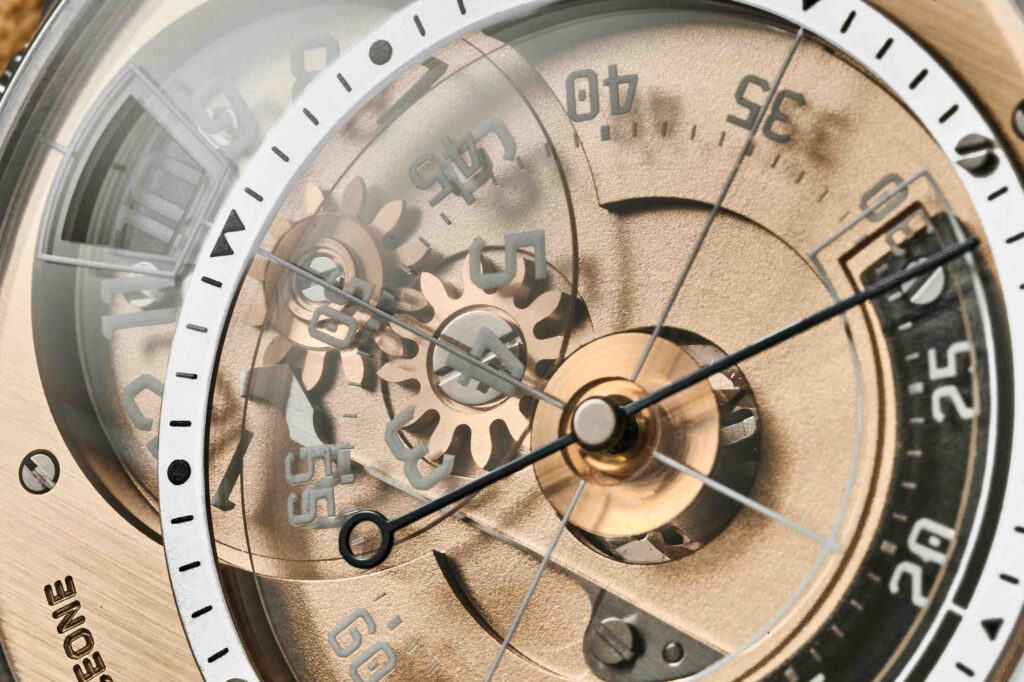
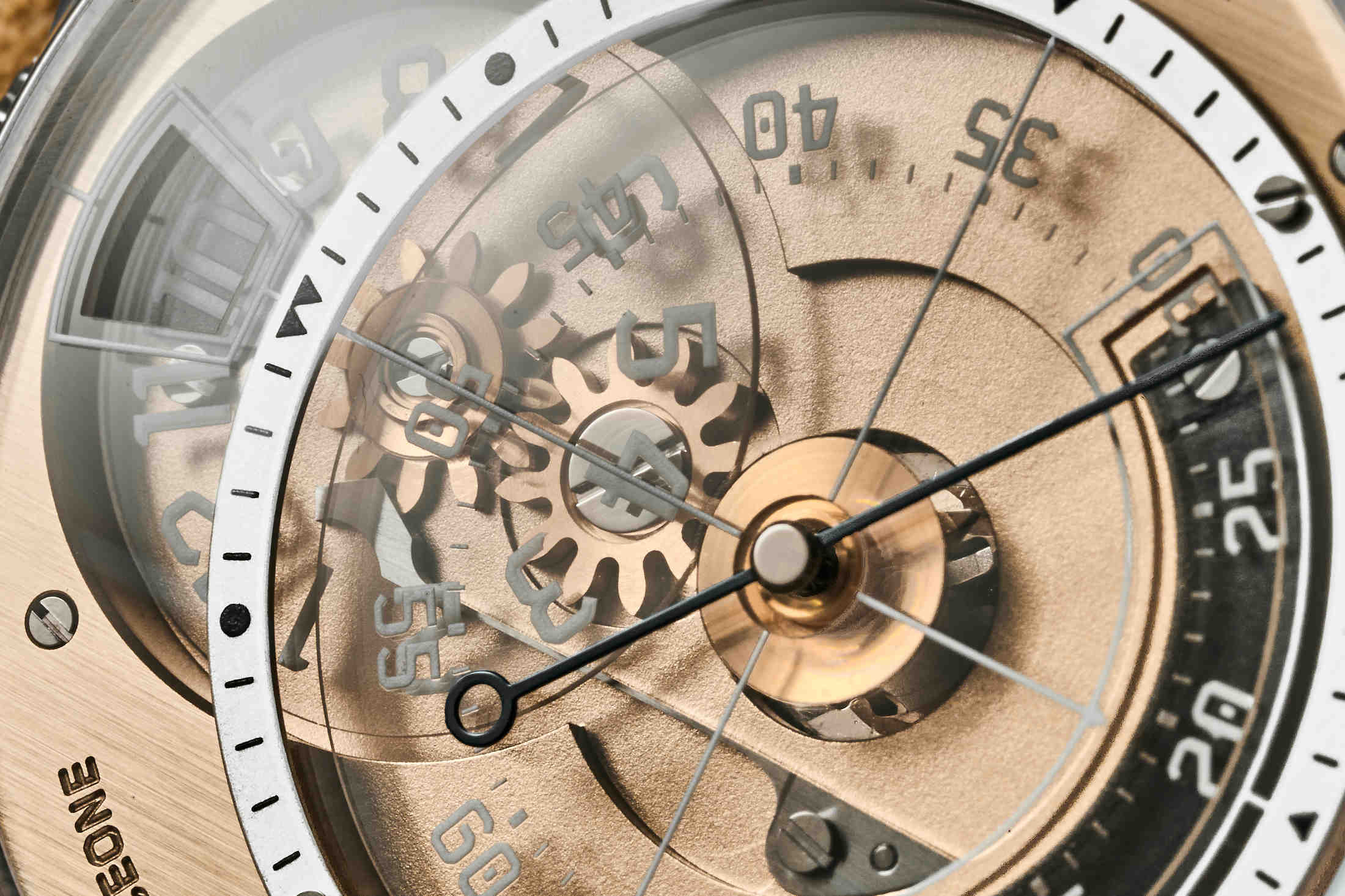
There is no traditional dial. The movement’s maillechort mainplate — machined from a single piece of German silver — functions as the visual canvas. Its warm, gold-adjacent tone provides the foundation against which the complication reads. That mainplate is available in two finishes: a straight unidirectional brushing, precise and restrained; or Auffret’s charbonné technique, an entirely hand-applied coal-finish requiring up to three hours of work per piece that produces an irregular, crystalline shimmer. No two charbonné dials are identical. Each carries the particular character of the hand that made it.
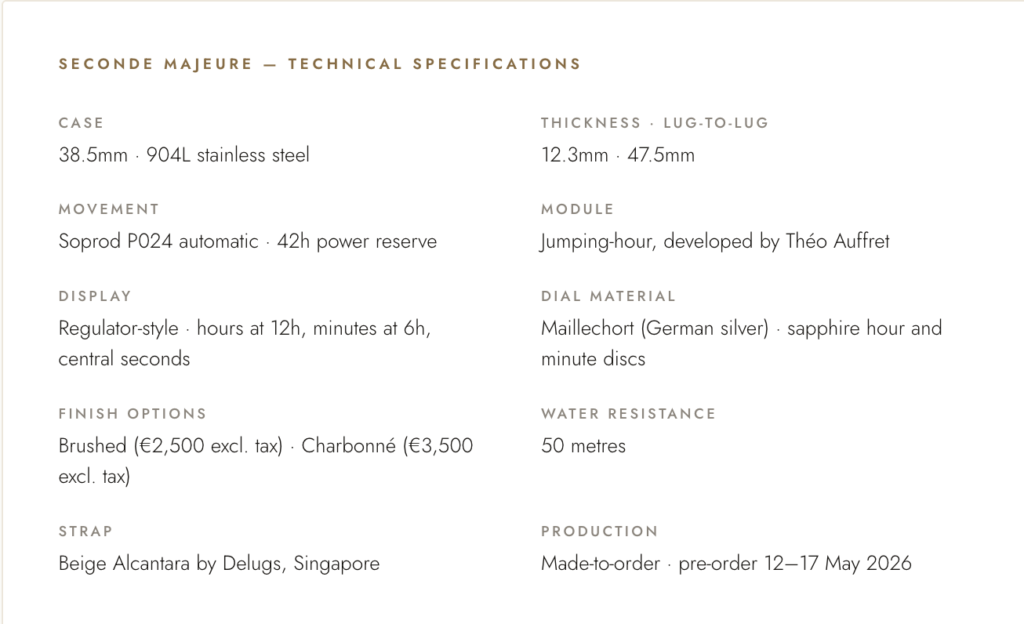
The complication itself is a regulator-style jumping hour. Hours and minutes are separated across two planes — hours on a sapphire disc at 12 o’clock, minutes on a corresponding disc at 6 o’clock, each read against a crosshair pointer. A large central seconds hand — the Seconde Majeure of the name — sweeps across both, lending visible motion to a display that would otherwise appear nearly still. Beneath the minute disc, a central control wheel completes one full rotation per hour. At the end of that cycle, it engages a 12-tooth star wheel attached to the hour disc, releasing a jumper spring and advancing the hour indicator in a single discrete step. The mechanism is visible. The intent is legible. For a watch at this price, it is an unusual level of exposure.
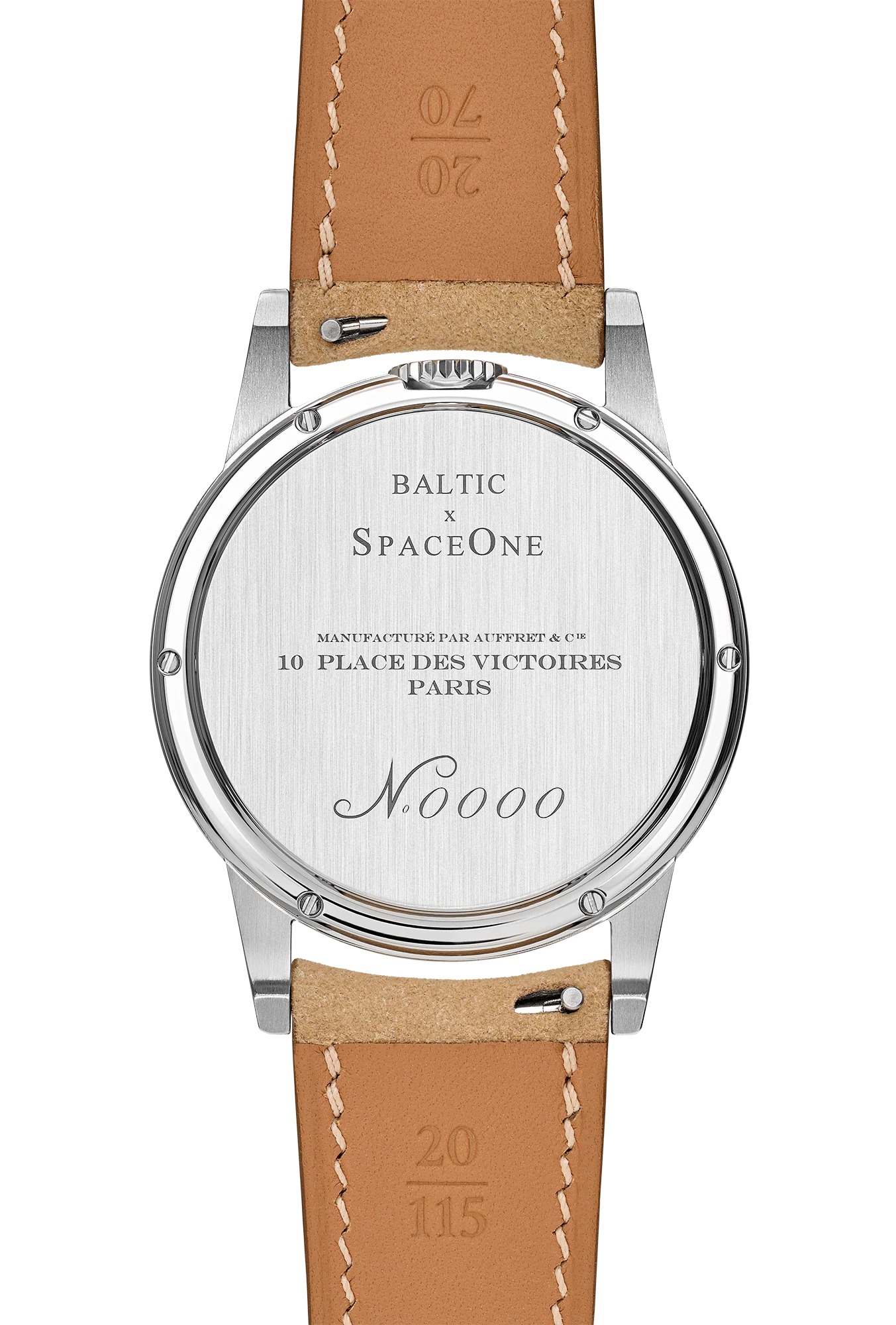
The caseback is solid steel, stepped, and engraved with the address of Auffret’s atelier — 10 Place des Victoires — alongside an individual production number. Each piece is registered to a place and a maker. That is not a trivial gesture.
PRE-ORDER STARTS ON 12 MAY, VISIT SPACEONE FOR MORE INFORMATION.
Interview By: Mr Luxury
This site uses cookies to offer you a
better browsing experience.